The Best Fluffy Pancakes recipe you will fall in love with. Full of tips and tricks to help you make the best pancakes.
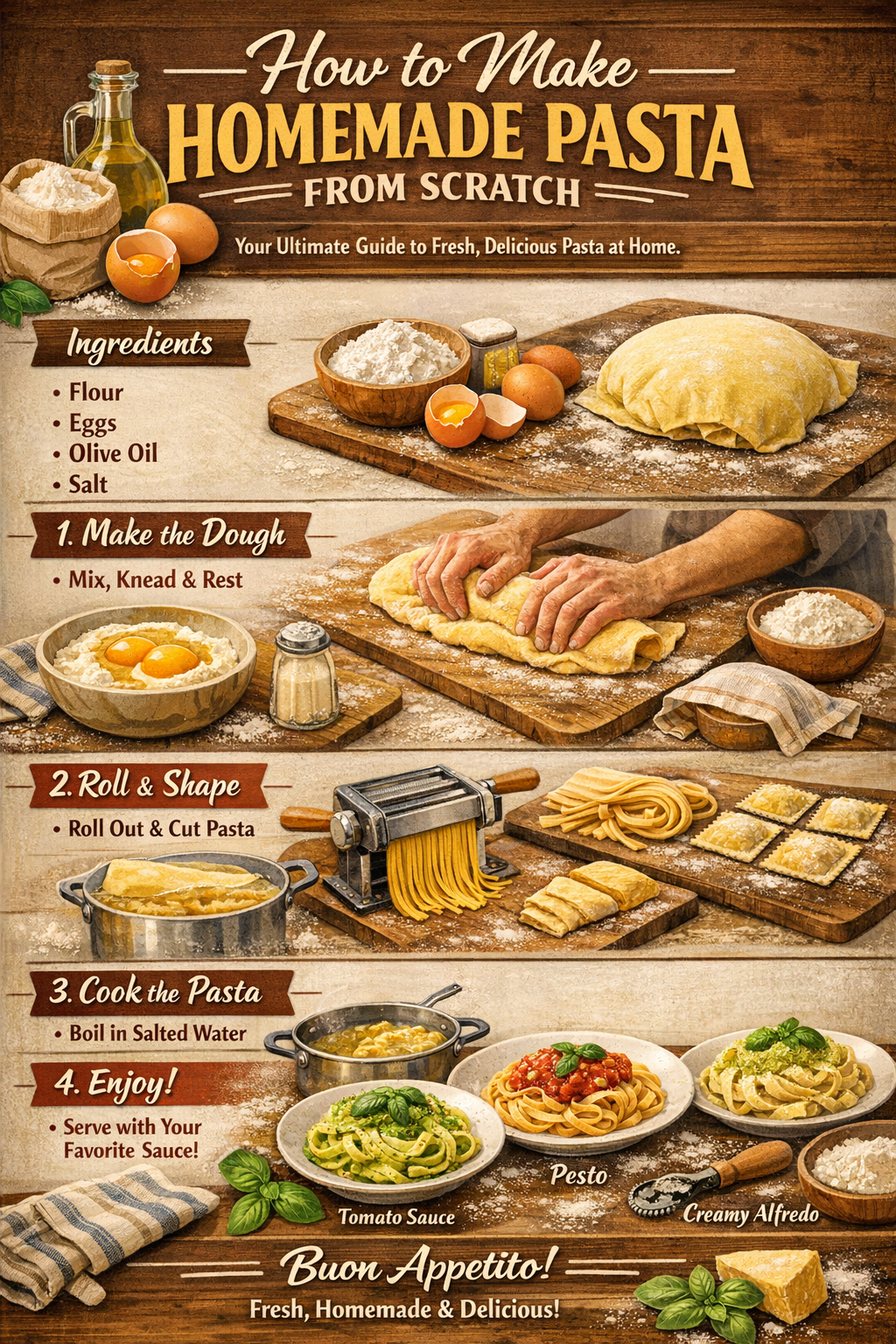

There’s a moment that happens the first time you make homemade pasta. You’ve rolled it out, cut it into ribbons, let it hang over a chair back or a broom handle propped between two counters — and then you drop it into boiling water and it cooks in literally two minutes and you eat it and think: why have I been buying the dry stuff my whole life?
That moment is real. And I want you to have it.
Homemade pasta has a reputation for being complicated, labor-intensive, or something that only Italian grandmothers who’ve been doing it for sixty years can pull off properly. And while I understand where that impression comes from — there’s a certain mythology around hand-rolled pasta that makes it sound intimidating — the reality is considerably more accessible than that.
The actual process? Four ingredients, one bowl, a rolling pin, and about an hour of your time the first time (less after that, once the technique clicks). No pasta machine required, though it helps. No specialized equipment. No culinary degree.
What you do need is a willingness to get your hands floury, a bit of patience during the kneading stage, and the understanding that fresh pasta behaves differently than dried pasta in ways that are almost entirely positive once you know what to expect.
This is your complete guide. By the end of it, you’ll know how to make the dough, roll it, cut it into several shapes, cook it properly, and pair it with sauces that do justice to fresh pasta’s genuinely superior texture and flavor. Let’s get into it.
Why Make Pasta at Home? (The Honest Case)
Before we get into technique, let’s actually make the case for doing this — because it does require more effort than opening a box, and that effort deserves justification.
The texture is genuinely better. Fresh pasta has a silky, tender bite that dried pasta simply doesn’t have. It’s not better in a snobbish way — it’s better in a physical, eat-it-and-notice-the-difference way. Where dried pasta has chew and springiness, fresh pasta has softness and a kind of delicate richness that comes from the eggs in the dough.
It cooks in two to four minutes. Once you’ve made fresh pasta, the cooking time becomes almost absurdly fast. Drop it in boiling water, look at your phone for two minutes, drain it, done. Compare that to eight to twelve minutes for dried pasta.
The ingredients are things you already have. Flour, eggs, a pinch of salt, sometimes a drizzle of oil. That’s it. You probably have all of these right now.
It’s genuinely satisfying to make. This isn’t nothing. Kneading pasta dough, rolling it thin, cutting it into noodles — it’s tactile and rhythmic in a way that a lot of cooking isn’t. A lot of people find it meditative. Some people find it therapeutic. It’s definitely more interesting than boiling water and opening a box.
It freezes beautifully. Make a big batch, freeze it in portions, and you essentially have homemade fresh pasta on demand for weeks. That’s a legitimate time investment that pays ongoing dividends.
Now — the honest downsides. It does take time, especially the first couple of times while you’re still calibrating your dough and rolling technique. If you’re trying to get dinner on the table in twenty minutes on a Tuesday night, this is probably not the night to try homemade pasta for the first time. And the rolling process, if you’re doing it by hand, requires some space and a fair amount of physical effort.
But for a weekend dinner, a date night, a family occasion, or genuinely any time when cooking is a pleasure rather than a chore — homemade pasta is one of the most rewarding things you can make.
The Basic Ingredients: Less Is More Here
Part of what makes homemade pasta so satisfying is how few ingredients it needs. Understanding what each one does helps you make better decisions and troubleshoot if something isn’t working.
Flour: The Foundation
The most common question in homemade pasta is: what flour should I use? And the answer depends slightly on what kind of pasta you’re making.
“00” flour (doppio zero) is the Italian standard for fresh pasta and is widely available at specialty stores and increasingly at regular supermarkets. It’s milled very finely, which produces a silky, smooth, supple dough that’s a pleasure to work with and rolls out beautifully thin. If you can get it, use it — especially for delicate shapes like tagliatelle and pappardelle.
All-purpose flour works well and is probably already in your kitchen. It produces a slightly chewier, more rustic pasta than 00 flour. Perfectly delicious, just a bit different in texture. Great for everyday pasta making.
Semolina flour (made from durum wheat) has a coarser grind and produces a firmer, slightly gritty dough with a golden yellow color and nutty flavor. Difficult to roll thin by hand but excellent for extruded pasta shapes and certain regional recipes. Often blended with 00 or all-purpose flour in a 50/50 ratio for a middle-ground result.
A practical suggestion: Start with all-purpose flour if that’s what you have. Once you’ve made pasta a few times and want to explore further, try 00 flour for a noticeably different (and very lovely) result.
Eggs: The Binding Agent and the Flavor
Traditional Italian egg pasta uses whole eggs, egg yolks, or a combination. More egg yolks mean a richer, more golden, more flavorful dough that rolls out silkier and produces a more luxurious finished pasta. This is why some high-end pasta recipes call for six or eight yolks per cup of flour — the result is extraordinary but also requires more technique.
For a beginner’s recipe, a combination of whole eggs and an extra yolk or two hits the right balance between richness, ease of handling, and flavor.
Room temperature eggs incorporate into the dough more smoothly than cold ones. Take them out of the fridge 20–30 minutes before starting.
Salt
A pinch in the dough adds baseline flavor, but don’t rely on it — most of your seasoning comes from well-salted pasta water and the sauce. In the dough itself, salt also affects gluten development slightly, making the dough a bit more extensible.
Olive Oil
Some recipes include a small drizzle of olive oil in the dough; others don’t. When included, it adds richness, makes the dough slightly more pliable and easier to roll, and gives the finished pasta a subtle depth of flavor. It’s optional but worth including, especially if you’re making pasta by hand and want the most cooperative dough possible.
The Master Recipe: Fresh Egg Pasta Dough
This is the foundational recipe that everything else builds on. Once you’ve made this a few times, you’ll adjust intuitively based on your flour, your eggs, and the humidity in your kitchen.
Ingredients (serves 3–4 as a main, 4–6 as a starter):
- 300g (about 2½ cups) “00” flour or all-purpose flour, plus more for dusting
- 3 large eggs, room temperature
- 1 egg yolk (extra richness — optional but recommended)
- 1 teaspoon olive oil
- Pinch of fine salt
Step 1 — Making the Dough
The well method (traditional): Mound the flour on a clean work surface. Make a wide, deep well in the center with your hands — wide enough to hold the eggs without them escaping. Crack the eggs, yolk, olive oil, and salt into the well. Using a fork, beat the eggs gently in the well, slowly incorporating flour from the inner walls. Work gradually — you’re not trying to mix everything at once, just slowly pulling flour into the egg mixture until it becomes too thick to use the fork. Switch to your hands and bring everything together into a rough, shaggy dough.
The bowl method (easier for beginners): Combine everything in a mixing bowl with a fork until a rough dough forms, then turn it out onto the work surface for kneading. Less dramatic, equally effective.
Either method produces the same end result. The well method is the classic, photogenic approach. The bowl method is more forgiving if you’re new to this.
Step 2 — Kneading
This is the most important step and the one that takes the most time: 8–10 minutes of firm, rhythmic kneading by hand.
Push the dough away from you with the heel of your hand, fold it back toward you, rotate it a quarter turn, and repeat. You’ll notice the dough change as you work it — it starts out rough and slightly sticky, then gradually becomes smoother, more elastic, and more cohesive. By the end, it should feel like smooth leather or a firm earlobe (yes, that’s the standard comparison, and yes, it’s accurate).
Why does kneading matter so much? Because you’re developing the gluten network — the structure that gives the pasta its texture and allows it to be rolled thin without tearing. Under-kneaded dough tears easily and produces pasta with an inconsistent, slightly grainy texture. Properly kneaded dough is a pleasure to work with.
If the dough feels too sticky during kneading, add flour a tiny pinch at a time. If it feels too dry and cracks rather than stretching, wet your hands slightly and continue kneading. The dough should be firm but not stiff, smooth but not tacky.
Step 3 — Resting
Once kneaded, wrap the dough tightly in plastic wrap and let it rest at room temperature for at least 30 minutes. An hour is even better.
This step matters more than most people realize. During rest, the gluten relaxes — which means the dough becomes much more extensible and easier to roll without springing back. Try rolling pasta dough immediately after kneading and it’ll fight you constantly, shrinking back every time you roll it out. After resting, it stays where you put it.
Don’t skip this step. Make the dough, set a timer, go do something else, come back.
Step 4 — Rolling
Here’s where you have two options: rolling by hand with a rolling pin, or using a pasta machine.
By hand: Divide the dough into four portions (working with one at a time, keeping the others covered). On a lightly floured surface, roll the dough with a long rolling pin, working from the center outward in all directions. The goal is to get it thin — genuinely thin. For most pasta shapes, you’re aiming for about 2mm thickness, roughly the thickness of a playing card. For stuffed pasta like ravioli, even thinner — 1mm, almost translucent.
Roll, rotate, roll again. The dough will try to spring back slightly; let it rest for a minute if it’s resisting, then continue. Keep the surface lightly floured to prevent sticking.
With a pasta machine: Run the dough through the widest setting several times first, folding it between passes — this actually finishes developing the gluten and produces a smoother result. Then progress through the settings one or two at a time until you reach your desired thickness (usually setting 5 or 6 out of 9 for most pasta shapes).
The machine produces more consistent, faster results, especially for thinner pasta. But hand-rolling produces pasta with slight variations in thickness that actually cook beautifully and give a more rustic, handmade character. Neither is objectively better — they’re different.
Step 5 — Cutting
Once rolled, the dough is ready to cut. Work quickly — rolled pasta dries out and becomes brittle if left too long.
For tagliatelle or fettuccine: Flour the sheet lightly, roll it loosely like a scroll, and cut across into ribbons about 6–7mm wide. Unfurl them immediately and dust with more flour to prevent sticking.
For pappardelle: Same method, but cut wider — about 2–2.5cm ribbons.
For tagliolini or spaghetti alla chitarra: Cut into very thin ribbons, 2–3mm wide.
For lasagne sheets: Cut into large rectangles to fit your baking dish.
For farfalle (bow ties): Cut the sheet into small rectangles, then pinch the center of each one firmly between your thumb and index finger to form the bow tie shape.
Once cut, either cook immediately (best), hang loosely to dry for up to 30 minutes before cooking, or toss with flour and shape into loose nests to refrigerate for up to 24 hours.
How to Cook Fresh Pasta Properly
Fresh pasta needs a lot of boiling, well-salted water. The water should taste like the sea — genuinely salty. This is where pasta gets most of its seasoning, and under-salted water produces flat-tasting pasta no matter how good the dough is.
Bring a large pot of water to a rolling boil. Add a generous amount of salt (about 1 tablespoon per liter of water as a starting point). Add the pasta and stir immediately to prevent sticking.
Cooking time for fresh pasta: 2–4 minutes, depending on thickness. Start tasting at 2 minutes. Fresh pasta is done when it’s tender but still has a very slight bite — al dente, which translates literally as “to the tooth.” It should never be mushy.
Reserve a cup of pasta water before draining — the starchy water is a powerful tool for finishing sauces and helping them cling to the pasta.
Drain and sauce immediately. Fresh pasta doesn’t hold well once cooked and drained — it sticks to itself quickly. Have your sauce ready and waiting, not the other way around.
Pasta Shapes and the Sauces That Suit Them
This is where Italian cooking philosophy becomes genuinely practical. Different pasta shapes pair with different sauces not because of arbitrary tradition but because of physical logic: the surface area, texture, and structure of each shape interacts differently with sauces of different consistencies.
Tagliatelle and Pappardelle
Wide, flat ribbons with a large surface area that catches thick, meaty sauces beautifully. Bolognese — a proper, slow-cooked meat ragù — is the classic pairing for tagliatelle for good reason. The sauce clings to every surface. Pappardelle’s extra width makes it ideal for even heftier ragùs: braised short rib, lamb shoulder, wild boar if you want to go full Italian countryside.
Classic sauce pairing: Bolognese ragù. Brown equal parts ground beef and pork (or just beef), build flavor with onion, carrot, celery and garlic, deglaze with white wine, add crushed tomatoes and whole milk, and simmer low and slow for at least 90 minutes. The milk is the secret — it softens the acidity of the tomatoes and gives the sauce a richer, rounded flavor.
Fettuccine
Slightly narrower than tagliatelle, fettuccine is the ribbon pasta associated with Alfredo-style cream sauces. The creamy coating clings to the flat surface and wraps around the noodle in a way that feels indulgent with every bite.
Classic sauce pairing: Fettuccine Alfredo. The real version — not the cream-heavy American interpretation — is made with just butter, parmesan, and pasta water. Cook the fettuccine, reserve pasta water, toss with cold butter and freshly grated parmesan over low heat, adding pasta water a little at a time to create a silky, emulsified sauce. Nothing else. It’s extraordinary when done right.
Tagliolini and Fresh Spaghetti
Thin, delicate noodles that pair best with light, refined sauces that don’t overwhelm them.
Classic sauce pairing: Cacio e Pepe. One of the most satisfying pasta dishes in existence: just pasta, pecorino romano, black pepper, and pasta water, worked together until creamy and intensely flavored. Every element matters. The pasta water, the quality of the cheese, the freshly cracked pepper. Nothing to hide behind.
Fresh Lasagne Sheets
The foundation for baked pasta dishes. The difference between dried lasagne sheets and fresh ones is significant — fresh sheets are silky and tender where dried ones, even when properly soaked, have more chew and structure.
Classic use: Lasagne al Forno. Layer fresh pasta sheets with Bolognese ragù, béchamel sauce, and parmesan. Bake until bubbling and golden. Simple on paper, extraordinary in execution.
Flavored and Colored Pasta Variations
Once you have the basic dough down, variations are genuinely fun to explore. The same dough recipe adapts easily to different flavors and colors with a few additions.
Spinach Pasta (Green)
Wilt and thoroughly squeeze dry about 100g of fresh spinach (or use 50g of frozen spinach, thawed and squeezed dry). Blend until smooth. Replace one of the whole eggs in the master recipe with the spinach purée. The dough will be slightly stickier — add flour as needed. The result is a beautiful deep green pasta with a mild, slightly earthy flavor.
Tomato Pasta (Orange-Red)
Add 2 tablespoons of concentrated tomato paste to the egg mixture before combining with the flour. The color is a warm terracotta orange and the flavor is subtle but present. Pairs beautifully with cream-based sauces.
Squid Ink Pasta (Deep Black)
Add 1–2 teaspoons of squid ink (available in small sachets at fish markets and specialty stores) to the eggs. The dough turns an extraordinary deep blue-black. The flavor is mildly briny and oceanic. The visual impact is dramatic. Pairs perfectly with seafood — clams, shrimp, scallops, or a simple garlic and olive oil base with fresh parsley.
Beetroot Pasta (Pink-Magenta)
Roast and purée a small beetroot, then use 2–3 tablespoons of the purée in place of one egg. The color ranges from pale pink to vivid magenta depending on how much you add. Earthy, slightly sweet flavor. Excellent with goat cheese and walnut sauces.
Black Pepper Pasta
Add a generous amount of freshly cracked black pepper directly to the dough — about 1½ teaspoons for the master recipe. No color change, but the flavor runs through every bite. Particularly good for Cacio e Pepe where you want the pepper to be present at every level.
Making Stuffed Pasta: Ravioli and Tortellini
Once you’re comfortable with the basic flat pasta shapes, stuffed pasta is the natural next step — and it opens up an enormous range of creative possibilities.
The principle is the same: roll the dough thin (thinner than for flat pasta — you want to taste the filling, and double layers of dough can become thick and chewy if not rolled fine enough), add filling, seal, and cut or shape.
Classic Ricotta and Spinach Ravioli
For the filling: Combine 250g whole-milk ricotta (drained overnight in a sieve for a firmer result), 100g cooked and very thoroughly squeezed spinach (chopped fine), 50g grated parmesan, 1 egg yolk, a pinch of nutmeg, salt, and pepper.
To assemble: Roll the dough into long, thin sheets. Place teaspoon-sized portions of filling at regular intervals (about 4cm apart) along one half of the sheet. Fold the other half of the sheet over the filling, press firmly around each mound of filling to eliminate air bubbles (air pockets cause ravioli to burst during cooking), and cut into squares or rounds with a pastry wheel or knife. Press edges firmly to seal — a little egg wash helps.
To cook and serve: Boil for 3–4 minutes. Drain gently. Serve with brown butter and sage (classic), a simple tomato sauce, or a light cream sauce. The filling should be the star — don’t overwhelm it.
Storing and Freezing Fresh Pasta
One of the underrated benefits of homemade pasta is how well it stores once you’ve put in the effort.
Refrigerating: Toss cut pasta with a little flour to prevent sticking, shape into loose nests, and store in an airtight container in the fridge. Use within 2 days for best results.
Freezing: Arrange the pasta nests on a parchment-lined baking sheet and freeze until solid — about 30–60 minutes. Transfer to freezer bags. Cook directly from frozen, adding an extra minute or two to the cooking time. Quality remains excellent for up to 2 months.
Drying: Hang pasta over a drying rack or a floured surface for several hours until completely dry and brittle. Store in an airtight container at room temperature for up to a week. Cooking time increases slightly compared to fresh pasta.
Troubleshooting Common Homemade Pasta Problems
Because things don’t always go perfectly the first time, and knowing what went wrong helps you fix it.
Dough is too sticky: Add flour a pinch at a time and keep kneading. Different flours absorb differently, and eggs vary in size — small adjustments are normal.
Dough is too dry and cracks: It needs more moisture. Wet your hands slightly and continue kneading, or add a few drops of water.
Dough tears when rolling: It probably needs more rest. Wrap it and let it sit another 15–20 minutes. If it still tears, it may be under-kneaded.
Pasta sticks together after cutting: Not enough flour dusting, or it sat too long before cooking. Keep cut pasta well-floured and cook it quickly.
Pasta turns mushy when cooked: It was cooked too long. Fresh pasta cooks very fast — start checking at 2 minutes and don’t walk away.
Ravioli bursting during cooking: Air pockets in the filling or insufficiently sealed edges. Press around each pocket very firmly to remove air before sealing.
Conclusion: Fresh Pasta Is One of Those Skills That Rewards You for Life
There’s something about homemade pasta that accumulates value the more you make it. The first time is a bit uncertain, a bit floury, a bit longer than you expected. By the fifth time it’s almost effortless. By the tenth time you’re adjusting the dough by feel, rolling it out in fifteen minutes, and making shapes you’ve never tried before.
It becomes, genuinely, one of the most satisfying and versatile skills in your cooking repertoire. Because once you understand the dough — how it should feel, how it should roll, how it behaves — you have the foundation for hundreds of dishes. Every stuffed pasta. Every regional variation. Every colored dough. Every classic sauce combination. All of it flows from those four simple ingredients kneaded together on a floured surface.
So start simple: the master recipe, a rolling pin, a knife, and a batch of tagliatelle with whatever sauce appeals to you most. Get your hands floury. Notice how the dough changes as you knead it. Experience that two-minute cooking time for the first time and understand why people who make pasta at home rarely go back to dried.
Fresh pasta is one of those cooking skills that sounds impressive, feels meditative to practice, produces extraordinary results, and is — once you’ve done it a few times — genuinely not that hard. That combination is rare. It’s worth your time.
I’d genuinely love to hear how it goes for you! Is this your first time attempting homemade pasta, or have you tried before and run into trouble? Drop a comment and let me know — and if there’s a specific pasta shape or dish you’ve been wanting to master, leave it in the comments below. Your next challenge might become the next article.