The Best Fluffy Pancakes recipe you will fall in love with. Full of tips and tricks to help you make the best pancakes.
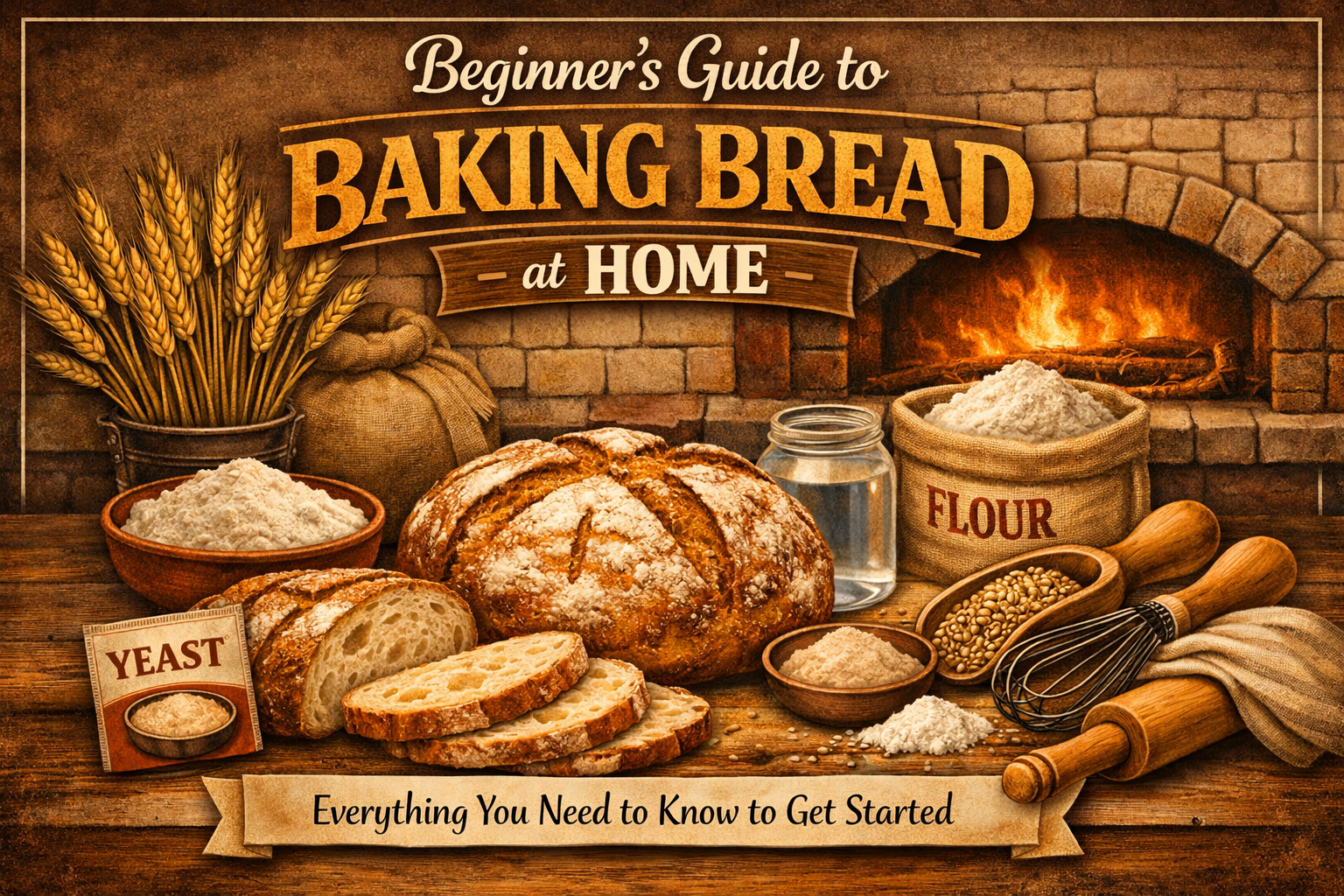

There’s a moment — and if you’ve ever baked your own bread, you know exactly which one I’m talking about — when you pull a golden loaf out of the oven, the kitchen smells absolutely incredible, and you think: I made this. With my own hands. From scratch.
It’s a genuinely satisfying feeling. Almost disproportionately satisfying for what is, at its core, a mix of flour, water, salt, and yeast.
But here’s the honest truth that most beginner baking guides skip straight past: that moment doesn’t always come easy at first. Bread baking has a bit of a learning curve — not because it’s technically complicated, but because it requires you to understand what you’re doing and why, rather than just following steps blindly and hoping for the best.
If you’ve ever tried to bake bread at home and ended up with something dense, flat, gummy in the middle, or with a crust you could use as a weapon — this guide is for you. And if you’ve never tried at all but have been curious about it, this is also very much for you.
We’re going to cover everything a true beginner needs to know: the ingredients, the equipment, the process, the science (just enough of it, I promise — nothing too nerdy), the most common mistakes, a simple starter recipe, and the tips that actually make a difference. By the end of this guide, you’ll have a real foundation to start baking bread at home with confidence.
Let’s begin.
Why Bake Bread at Home in the First Place?
Fair question. There’s perfectly decent bread at every grocery store. Why go through the effort?
A few reasons that are genuinely worth considering:
You know exactly what’s in it. Most commercial breads — even the ones that look wholesome on the package — contain a list of additives, preservatives, dough conditioners, and emulsifiers you’d never add at home. When you bake your own bread, the ingredient list is short and readable.
It’s cheaper than you think. A basic loaf of homemade bread costs a fraction of what you’d pay for a quality artisan loaf at a bakery. Flour, yeast, salt, and water are among the least expensive ingredients in any kitchen.
It’s genuinely therapeutic. There’s something about the physical act of kneading dough — the repetitive motion, the feel of it changing under your hands — that a lot of people find calming. It’s one of those rare activities that forces you to slow down and be present.
And it tastes better. Not always more “perfect” than a professional loaf. But there’s a warmth and satisfaction in homemade bread that you just can’t buy.
Vale dizer: home baking bread isn’t going to be effortless right away. Your first loaf might not be Instagram-worthy. But that’s completely okay — because every loaf teaches you something, and most imperfect loaves still taste wonderful.
Understanding the Basics: What Bread Actually Is
Before we talk about how to make it, it helps to understand what bread actually is at its core. Don’t worry — this is quick and genuinely useful.
Bread is, essentially, a fermented dough. You mix flour and water, which creates a structure. Then you add yeast, which eats the sugars in the flour, produces carbon dioxide gas, and makes the dough rise. The gluten network (developed through mixing and kneading) traps those gas bubbles, which is what gives bread its airy, open texture. Then heat bakes that structure into place, drives off the moisture, and creates the crust.
That’s the whole arc of bread baking, right there. Every step in the process — the mixing, the resting, the shaping, the rising, the baking — serves that arc.
And here’s a point worth making: most beginner problems with bread can be traced back to one of just a few things going wrong in that arc. Once you understand the chain, troubleshooting becomes a lot less mysterious.
The Four Ingredients of Basic Bread
Let’s talk about what you actually need. For a classic, no-frills white bread loaf, you need exactly four ingredients:
1. Flour
All-purpose flour works. Bread flour works better.
The difference? Protein content. Bread flour has more protein than all-purpose, which means it develops more gluten — and more gluten means better structure, better rise, chewier texture. If you’re serious about getting into bread baking, bread flour is worth buying. But if you start with all-purpose, your bread will still be bread. It just might be slightly denser.
Whole wheat flour is another option, and it adds flavor and fiber. The trade-off is that it makes the dough heavier and the bread denser, because the bran particles cut through the gluten strands. If you want to use whole wheat, start by substituting just a portion of the all-purpose flour — say, 25–30% — rather than going 100% whole wheat right away.
2. Water
Sounds obvious, but the temperature matters more than most beginners realize. Yeast is a living organism, and it’s picky about temperature. Water that’s too cold slows it down dramatically. Water that’s too hot (above around 60°C / 140°F) kills it.
The ideal temperature for activating yeast is somewhere between 35–43°C (95–110°F). A useful test: it should feel warm on the inside of your wrist, like bath water. Not hot. Not cold. Warm.
3. Yeast
There are a few types you’ll encounter:
Active dry yeast — the most common kind. Needs to be dissolved in warm water before using (this is called “proofing”). Little beige granules, usually sold in packets or jars.
Instant yeast (also called rapid-rise or bread machine yeast) — more finely milled, can be mixed directly into the dry ingredients without proofing first. Works faster than active dry yeast.
Fresh yeast — a solid cake of living yeast, more common in professional bakeries. Works wonderfully but has a short shelf life. If you see it at a specialty store, give it a try eventually — but for now, active dry or instant yeast is completely sufficient.
For this beginner’s guide, we’ll use active dry yeast. It’s widely available, reliable, and teaches you the good habit of checking whether your yeast is actually alive before you invest 2 hours in a dough.
4. Salt
Salt does more than add flavor (though it does add a lot of flavor). It also strengthens the gluten structure and slows fermentation slightly, which gives the bread more complexity and control. Don’t skip it. And don’t add it directly on top of the yeast when mixing — high concentrations of salt can inhibit or even kill yeast. Mix them separately and combine everything together.
Equipment: What You Actually Need vs. What’s Nice to Have
Good news: you don’t need a lot to get started with home bread baking. Here’s the honest breakdown.
You Actually Need:
- A large mixing bowl — big enough to hold your dough with room to rise
- A wooden spoon or dough whisk — for initial mixing
- Your hands — seriously, the best kneading tool you have
- A loaf pan (9×5 inch) — for sandwich-style bread, or a baking sheet for a freeform loaf
- A kitchen towel or plastic wrap — for covering the dough while it rises
- An oven — preheated properly, ideally with a thermometer to check it runs accurately
That’s it. That’s really all you need for a first loaf.
Nice to Have (But Not Essential):
- A kitchen scale — highly recommended, actually. Measuring flour by weight is significantly more accurate than by volume, and consistency matters in baking.
- A bench scraper — helps with shaping and cleanup
- A Dutch oven — if you want to bake artisan-style round loaves (boules) with a crackly crust. The enclosed environment traps steam and mimics a professional bread oven.
- An instant-read thermometer — for checking dough temperature and confirming when bread is fully baked internally
The Bread Baking Process, Step by Step
Here’s the full process for a basic white sandwich bread. Read through it completely before you start — understanding the whole arc first makes each step make more sense.
Step 1: Proof the Yeast (5–10 Minutes)
In a small bowl or measuring cup, combine:
- 240ml (1 cup) warm water (35–43°C / 95–110°F)
- 1 teaspoon sugar
- 2¼ teaspoons active dry yeast (one standard packet)
Stir gently and let it sit for 5–10 minutes. You’re looking for it to become foamy and bubbly on top. That foam is the yeast producing gas — it means it’s alive and active. If nothing happens after 10 minutes, your yeast is dead or your water was too hot/cold. Start over. Don’t proceed with dead yeast — you’ll end up with a dense brick.
Step 2: Mix the Dough
In a large bowl, combine:
- 480g (about 4 cups) bread flour (or all-purpose flour)
- 1½ teaspoons salt
Make a well in the center and pour in the yeast mixture, plus an additional:
- 60ml (¼ cup) warm water (you can also substitute this with a tablespoon of olive oil for a slightly richer bread)
Mix with a wooden spoon until a shaggy, rough dough forms. It’ll look messy and uneven at first — that’s fine. Keep mixing until no dry flour remains.
Step 3: Knead the Dough (8–10 Minutes)
Turn the dough out onto a lightly floured surface. Now it’s time to knead.
Kneading develops gluten, which is what gives bread its structure. To do it: push the dough away from you with the heel of your hand, fold it back toward you, turn it a quarter turn, and repeat. It’s a push-fold-turn rhythm.
At first, the dough will be sticky and a bit unruly. Resist the urge to dump a ton of flour on it — a little stickiness is normal and correct. Add flour only a tablespoon at a time if it’s genuinely unworkable.
After about 8–10 minutes of kneading, the dough should be:
- Smooth and slightly tacky (not sticky)
- Elastic — it should spring back slowly when you poke it
- Soft — almost like an earlobe in consistency
That’s the texture you’re going for.
Step 4: First Rise (1–1.5 Hours)
Shape the kneaded dough into a ball. Lightly oil your large bowl and place the dough inside, turning it to coat. Cover with a clean kitchen towel or plastic wrap.
Set it somewhere warm. This is important — yeast works best in a warm environment. A good trick: turn your oven on to its lowest setting for 2 minutes, then turn it off. Place the covered bowl inside the (turned off) oven. It’ll be just warm enough to encourage rising.
Let the dough rise until it has roughly doubled in size. This usually takes 1 to 1.5 hours, depending on the room temperature and how active your yeast is.
And here’s a point worth making: this rise time is flexible. If your kitchen is cold, it might take 2 hours. If it’s warm, maybe 45 minutes. Use the doubling as your guide, not the clock.
Step 5: Punch Down and Shape
Once doubled, gently punch the dough down to release the gas. This is satisfying in a childish, deeply enjoyable way.
Turn it out onto a lightly floured surface. Pat or roll it into a rough rectangle about the width of your loaf pan. Then roll it up tightly from one of the short ends, like a scroll. Pinch the seam closed and tuck the ends under. Place it seam-side down in a greased loaf pan.
Step 6: Second Rise (45–60 Minutes)
Cover the pan loosely and let the dough rise again until it crowns about 2–3 cm above the rim of the pan. This second rise (called the “proof” by bakers) is shorter than the first.
Don’t skip this step. It’s what gives the final loaf its texture and height.
Meanwhile, preheat your oven to 190°C (375°F).
Step 7: Bake (30–35 Minutes)
Slide the loaf pan into the preheated oven. Bake for 30–35 minutes, until the top is deep golden brown. If you’re unsure whether it’s done, remove the bread from the pan and tap the bottom — a hollow sound means it’s cooked through.
For extra certainty, an instant-read thermometer inserted into the center should read around 90–93°C (195–200°F).
Step 8: Cool Completely Before Slicing
I know. It’s hard. The bread smells amazing and you want to tear into it immediately.
But here’s the thing: the bread is still cooking on the inside when it comes out of the oven. The steam needs to redistribute and the crumb needs to set. If you slice it too early, you’ll get a gummy, doughy interior that seems underdone even if it’s technically baked. Wait at least 45–60 minutes before cutting.
Worth it. I promise.
The Most Common Beginner Mistakes (And How to Avoid Them)
Dense, Heavy Bread
The most frequent beginner complaint. Usually caused by one of three things: yeast that wasn’t active, not enough kneading, or the dough not rising long enough. If your bread comes out like a brick, check those three things first.
Bread That Doesn’t Rise At All
Almost always a yeast problem. Either the yeast was expired, the water was too hot and killed it, or you forgot the proofing step. Always proof your yeast first and check for that foam.
Gummy Interior
Either underbaked, or you sliced it too soon. Give it a full bake time and resist cutting for at least 45 minutes after it comes out.
Crust That’s Too Hard
The crust hardens as it cools. To keep it softer, brush it with a little melted butter right when it comes out of the oven, and store the cooled loaf in a zip bag.
Dough That’s Way Too Sticky
You may have measured your flour by volume and come up short (this is why scales matter). Or you’re in a humid environment. Add flour a tablespoon at a time during kneading — but be patient, because a little tackiness is normal and will work itself out as you knead.
The Health Side of Homemade Bread
Since we’re a health and recipes blog, this feels worth addressing properly.
Bread has gotten a complicated reputation in the last decade or so. Low-carb diets, gluten-free trends, and various wellness movements have made a lot of people feel like eating bread is somehow problematic. And while there are real reasons some people need to avoid gluten (those with celiac disease or genuine gluten sensitivity), for most people, bread is a perfectly normal, nourishing part of a balanced diet.
Homemade bread specifically has a few genuine advantages over most commercial varieties:
- No preservatives or additives — just the four ingredients you put in yourself
- Lower sodium if you control the salt
- No high-fructose corn syrup or dough conditioners that show up in many commercial loaves
- More satisfying and filling than highly processed bread, which tends to be quickly digested
Na prática: if you’re eating a balanced diet with plenty of vegetables, protein, and whole foods — a slice or two of homemade bread is not your enemy. Enjoy it.
Practical Tips That Actually Make a Difference
A few final notes that don’t fit neatly into any one section but genuinely matter:
Use a scale, not measuring cups. Flour is especially tricky to measure by volume — you can easily end up with 20–30% more or less than intended depending on how you scoop. A kitchen scale costs very little and transforms your consistency.
Temperature matters everywhere. Not just the water for the yeast. Your kitchen temperature, the temperature of your ingredients — all of it affects fermentation speed and dough behavior. Cooler conditions = slower rise. That’s not necessarily bad; a slow rise actually develops more flavor. But be aware of it.
Don’t be afraid of a wet dough. Many beginners add too much flour to compensate for stickiness. A wetter dough produces a more open, tender crumb. Learn to work with slightly sticky dough by wetting your hands instead of flouring the surface excessively.
Keep notes. Seriously. Write down what you did, what worked, what didn’t. Bread baking involves a lot of variables, and your memory is less reliable than a few lines in a notebook when you’re trying to figure out why last week’s loaf was better.
Your first loaf won’t be your best loaf. And that’s perfectly fine. Every loaf you bake teaches you something about how the dough feels, how your particular oven runs, how the timing works in your kitchen. Give yourself permission to learn.
Conclusion: The First Loaf Is the Hardest — and the Most Rewarding
Let’s bring it all together.
Baking bread at home for the first time feels a bit intimidating because there are several steps, a few things that can go wrong, and not a lot of instant feedback. But once you understand the basic arc — mix, knead, rise, shape, rise again, bake, cool — and once you know what to look for at each stage, it stops being mysterious and starts being genuinely enjoyable.
The four ingredients are simple. The equipment is minimal. The technique is learnable. And the result — a real, homemade loaf that came from your own kitchen — is worth every minute of the process.
Start with the basic white sandwich loaf we covered here. Get comfortable with it. Make it two or three times. And then, when you’re ready, start experimenting — different flours, adding seeds or herbs, trying a sourdough starter, baking in a Dutch oven for that artisan crust. The world of home bread baking opens up quickly once you have the fundamentals down.
I’d genuinely love to hear how your first loaf goes. Drop a comment below — did it come out the way you hoped? What went wrong? What surprised you? Real experiences from real beginners are some of the most useful things in the comments section of any baking guide, and your story might be exactly what someone else needs to read before they try.
And if there’s a specific bread you’d like to learn next — whole wheat, focaccia, sourdough, rolls, flatbread — let me know below. I’ll cover it.
Disclaimer: This article is for informational and educational purposes only and does not constitute medical or nutritional advice. If you have dietary restrictions or health conditions, please consult a qualified professional before making changes to your diet.