The Best Fluffy Pancakes recipe you will fall in love with. Full of tips and tricks to help you make the best pancakes.
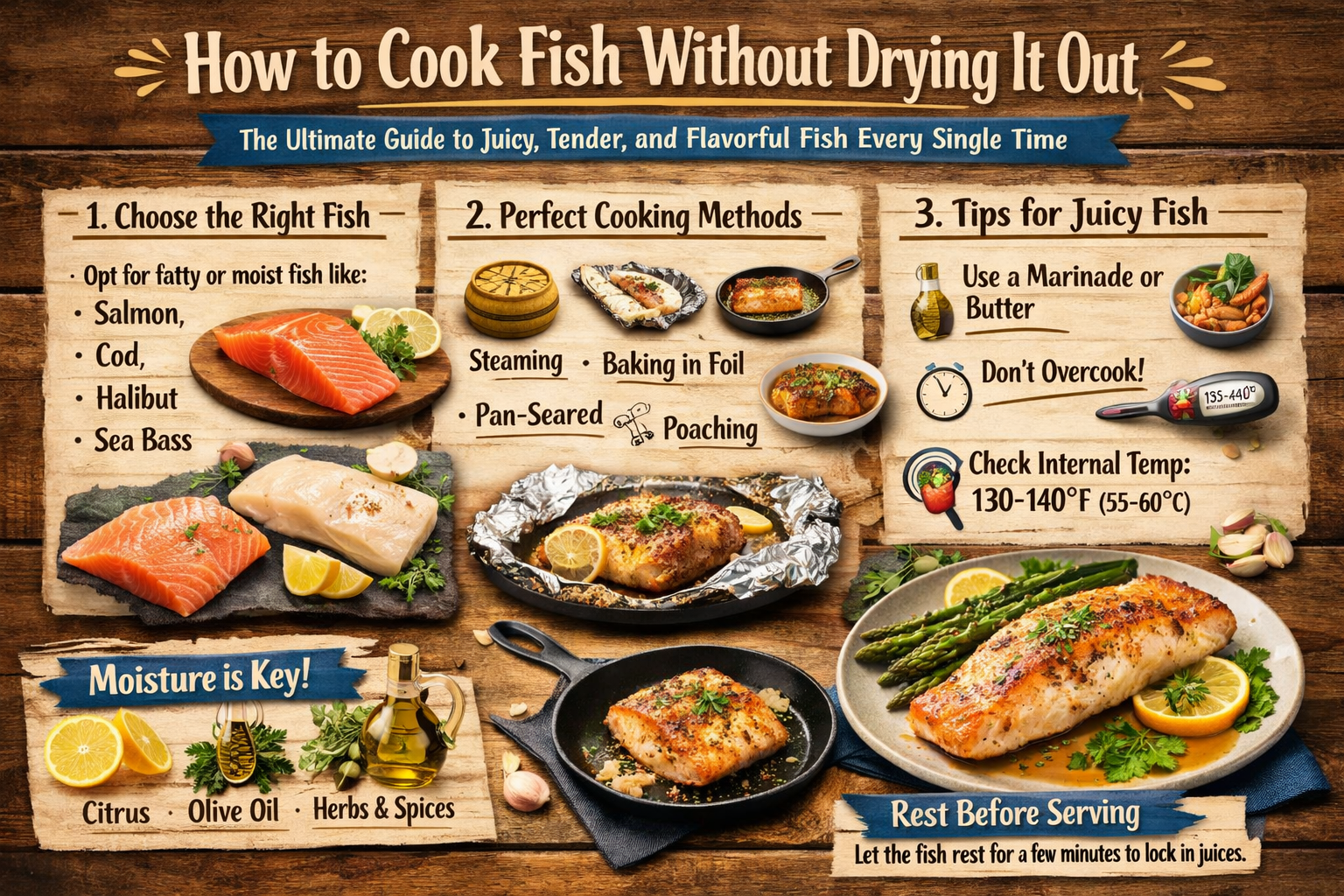

Fish is the ingredient that makes confident home cooks nervous. Not because it’s complicated — it’s actually one of the fastest proteins to cook. Not because it’s expensive — well, sometimes it is, but that’s a different problem. Fish makes people nervous because the margin between perfect and ruined is so narrow that it feels like it requires a level of precision most people aren’t sure they have.
You’ve probably experienced it. A beautiful piece of salmon that went from lustrous and just-done to dry and flaking apart in the time it took you to plate everything else. A cod fillet that was supposed to be delicate and flaky and came out more like fish-flavored cardboard. A tuna steak you were excited about that turned into something with the texture of canned tuna before it ever got near a can.
Here’s the thing nobody says clearly enough: cooking fish badly is almost always a heat and time problem. Fish is extraordinarily lean — even the fattier varieties like salmon and mackerel have less intramuscular fat than most cuts of beef or pork — which means when exposed to too much heat for too long, there’s very little built-in protection against moisture loss. The window between undercooked and overcooked is genuinely smaller than with other proteins, and most people consistently overshoot it because they’re applying the same instincts they use for chicken or beef.
But here’s the flip side: that same leanness and delicacy is what makes fish so uniquely satisfying when it’s cooked right. The tender flakes. The way good salmon practically melts. The clean, oceanic flavor of a perfectly seared piece of fish that hasn’t been cooked into submission. Getting this right isn’t difficult — it just requires understanding a few things that most recipes skip over in their rush to get to the ingredient list.
This guide covers all of it. The science of why fish dries out, the techniques that prevent it, the methods that work for different types of fish, the temperature targets that take all the guesswork away, and a collection of recipes built around the principle of juicy, tender, flavorful fish every time.
Let’s actually solve this.
Why Fish Dries Out: The Real Explanation
Understanding the problem is the first step toward consistently avoiding it — so let’s spend a moment here before getting into technique.
Fish muscle is structured differently from mammal muscle. Where beef and pork have long muscle fibers bundled into thick strands held together by connective tissue (collagen), fish has shorter muscle fibers arranged in sheets (called myotomes) separated by thin sheets of connective tissue (myocommata). This arrangement is why fish flakes naturally when cooked — the myotomes separate along the myocommata as the connective tissue breaks down.
The collagen in fish connective tissue converts to gelatin at around 45°C (113°F) — dramatically lower than the 70°C+ required for collagen conversion in tougher cuts of beef or pork. This is one of the things that makes fish cook so quickly. But it’s also why fish is so unforgiving: the entire cooking process from raw to done to overcooked happens within a temperature range of roughly 20°C (from about 45°C when the texture starts changing, to 65°C where it’s fully cooked, to 70°C+ where it becomes dry and chalky).
At the same time, the muscle proteins in fish — particularly the myosin proteins — start denaturing (unfolding and bonding together, squeezing moisture out of the cells) at around 40°C. The higher the temperature and the longer the exposure, the more moisture gets expelled. This is the exact same mechanism as in chicken and beef, just happening over a much smaller temperature range and much faster.
The practical upshot of all this biology: fish needs to be cooked to lower internal temperatures than most people cook it to, over moderate heat, for less time than most people give it. The instinct to cook it through until it’s clearly done — no translucency, no softness, clearly opaque throughout — usually means it’s already past its peak.
The target for most fish is an internal temperature of 52–60°C (125–140°F) for salmon, tuna, and other fatty fish (where a slightly translucent center is actually desirable), and 60–63°C (140–145°F) for lean white fish like cod, halibut, and sea bass. These temperatures feel undercooked to most people accustomed to cooking fish to 70°C+. They are not undercooked. They are correctly cooked.
The Most Common Fish Cooking Mistakes
Let’s name them specifically, because some are counterintuitive.
Cooking fish cold from the fridge. Cold fish placed on a hot pan creates a dramatic temperature differential between the exterior and interior. The outside hits high temperatures rapidly while the center is still cold — by the time the center reaches temperature, the exterior has been overcooked. Taking fish out of the fridge 15–20 minutes before cooking allows more even heat penetration.
Using heat that’s too high for too long. High heat is useful for developing a crust — but it needs to be reduced or the fish moved to gentler heat before the interior is ruined. Fish cooked at screaming-high heat from start to finish will always have an overcooked exterior by the time the center is done, especially for thick fillets.
Not patting fish dry before cooking. Moisture on the surface of fish creates steam when it hits the pan, which prevents the Maillard reaction (browning) from occurring and makes the fish stick. Pat fish completely dry with paper towels before any dry-heat cooking method. This single step dramatically improves the sear and the release from the pan.
Moving fish too soon. Fish sticks to the pan most aggressively when it first makes contact with hot metal. As the crust develops and the proteins set, the fish releases naturally. The instinct to check whether it’s sticking — by moving or lifting it early — tears the crust and often takes the skin with it. Place it skin-side down (or presentation-side down), and leave it until it releases without resistance.
Not using a thermometer. We said this about chicken and we’ll say it again about fish: guessing when fish is done is how you consistently overcook it. A thermometer removes the guessing and allows you to pull fish at exactly the temperature you want.
Cooking all fish the same way. Salmon and cod are not the same ingredient. Tuna and tilapia are not the same ingredient. Different fish have different fat contents, different textures, different ideal cooking temperatures, and respond to different methods. A method that works beautifully for one type of fish can be actively wrong for another.
Understanding Fish by Type: Match the Cooking Method to the Fish
This is the knowledge that makes everything else make sense. Fish can be roughly divided into categories based on fat content and texture, and the right cooking method follows from those properties.
Fatty Fish (Salmon, Mackerel, Sardines, Trout, Bluefish)
High in natural fat and omega-3 fatty acids, which provides built-in moisture protection during cooking. Fatty fish can handle higher heat and slightly longer cooking times than lean fish without drying out. The fat also means they pair well with acidic components — lemon, vinegar, capers — which cut through the richness.
Best methods: Pan-searing, roasting, grilling, curing, smoking, slow-roasting.
Internal temperature target: 52–57°C (125–135°F) for salmon and trout cooked to medium, where the center is still slightly translucent and melting. 60°C (140°F) for fully cooked but still moist. Beyond 63°C (145°F) and salmon becomes noticeably dry.
Lean White Fish (Cod, Halibut, Sea Bass, Sole, Flounder, Tilapia)
Low in fat, delicate in texture, and the most unforgiving category to cook. Without significant fat to protect against moisture loss, lean white fish dries out quickly at high temperatures. These fish need gentler heat, shorter cooking times, and — crucially — any method that keeps moisture around them as they cook.
Best methods: Poaching, steaming, gentle pan-searing with basting, en papillote (in parchment), gentle roasting. High-heat dry methods work but require precise timing.
Internal temperature target: 60–63°C (140–145°F). Unlike salmon, lean white fish is at its best when fully cooked — that clean, white, flaking texture requires full denaturation of the proteins. But it deteriorates rapidly above 65°C.
Firm-Fleshed Fish (Tuna, Swordfish, Mahi-Mahi, Monkfish)
These fish have a denser, meatier texture that handles direct high heat more like beef than like delicate white fish. Tuna in particular is often served rare to medium-rare in the center — the equivalent of a beef steak — and the comparison is apt: fully cooked tuna has the dry, flaky texture of canned tuna, while seared-rare tuna has the satisfying bite and juiciness of a well-cooked beef fillet.
Best methods: High-heat searing, grilling, quick pan-roasting.
Internal temperature target for tuna: 29–52°C (85–125°F) for rare to medium-rare. At 57°C+ it becomes noticeably dry. For swordfish and mahi-mahi: 57–63°C (135–145°F) for moist results.
Small Whole Fish and Shellfish (Sardines, Branzino, Shrimp, Scallops)
Each requires its own specific approach, but the overarching principle is speed. Small fish and shellfish cook in minutes — often seconds — and the window between perfect and overcooked is even narrower than with fillets.
Best methods for small whole fish: Grilling, pan-roasting, baking whole.
Best methods for shrimp: Quick sauté in very hot pan, poaching, grilling. Shrimp is done when it curls into a C shape and turns opaque — a tight, closed O shape means overcooked.
Best methods for scallops: High-heat searing in a screaming hot pan with clarified butter or high smoke-point oil. The entire cook is 90 seconds per side for most scallops. The goal is a deep, golden-brown crust on the flat sides with a barely-cooked, creamy center.
The Core Techniques for Moist, Tender Fish
Technique 1 — Pan-Searing with Skin On
Cooking fish with the skin on is a protective strategy as much as a flavor one. The skin acts as a buffer between the delicate flesh and the direct heat of the pan, allowing the interior to cook more gently while the skin develops a crispy crust. Done well, crispy fish skin is one of the genuine pleasures of cooking — it adds texture and flavor that makes the whole dish more interesting.
The method:
Start with fish that is completely dry (pat well with paper towels), skin-side seasoned with salt, brought close to room temperature.
Heat a heavy pan — stainless, cast iron, or carbon steel — over medium-high heat until genuinely hot. Add an oil with a high smoke point: avocado oil, grapeseed oil, clarified butter. The oil should shimmer and move fluidly when you tilt the pan.
Place the fish skin-side down. Press gently for the first 10–15 seconds to ensure the skin makes full contact with the pan — it has a tendency to curl away from heat. Then leave it completely alone.
For a 2.5cm thick salmon fillet, cook skin-side down for about 4–5 minutes until the cooked color has crept up about two-thirds of the way up the fillet. The skin should be deeply golden and crispy. Flip once, cook 30–60 seconds flesh-side down, then remove. Rest 1–2 minutes.
The interior should still look very slightly translucent at its thickest point — it will continue cooking from residual heat during rest.
The “never press the fish” caveat: After that initial 10-second press for contact, don’t press the fish again. Pressing squeezes out moisture. The fish needs to cook undisturbed to develop the crust.
Technique 2 — Slow Roasting
Slow roasting — cooking fish at 120–135°C (250–275°F) for an extended period — is the technique that produces the most consistently moist results for thick fillets and is almost impossible to get wrong. The low oven temperature means the fish can barely overshoot its target temperature even if you’re slightly late pulling it out.
The trade-off: no crust, no color. Slow-roasted fish is pale and unbrowned on the surface. You compensate with a sauce, a topping, or by finishing under the broiler briefly.
The method:
Season fish, place on a lightly oiled baking sheet or baking dish. Add aromatics — lemon slices, fresh herbs, a drizzle of good olive oil — on top and around. Place in a 120–135°C oven. Cooking time depends on thickness: a 2.5cm thick salmon fillet takes about 25–30 minutes at 120°C. A temperature probe in the thickest part is the most reliable indicator — pull at 52°C for salmon.
The result is extraordinary. The fish is moist throughout, the texture is silky and yielding, and the flavor is clean. This is the technique used in many high-end restaurants for salmon and halibut.
Technique 3 — Poaching
Poaching — cooking fish submerged in or just beneath the surface of barely simmering liquid — is the method that protects lean white fish most effectively. The liquid surrounding the fish acts as a temperature buffer, making it physically impossible for the fish to exceed the temperature of the poaching liquid, which you control.
The key to flavorful poached fish: court bouillon, or a well-seasoned poaching liquid. Plain water produces flavorless fish. A poaching liquid made from white wine, water, lemon, onion, peppercorns, bay leaves, and fresh dill (or whatever herbs suit the dish) infuses the fish as it cooks.
The method:
Bring the poaching liquid to a gentle simmer in a wide, shallow pan — the fish should fit in a single layer. Reduce to the lowest simmer possible — barely any movement on the surface. Add the fish. Cook until it’s just opaque throughout and the flesh flakes when pressed gently with a fork — typically 8–12 minutes depending on thickness for most white fish. Remove carefully with a slotted spatula.
Poached fish is excellent served with a rich sauce — beurre blanc, hollandaise, a cream and caper sauce — that compensates for the absence of browning.
Technique 4 — En Papillote (In Parchment)
Cooking fish en papillote — sealed in a folded parchment parcel with vegetables, herbs, aromatics, and a splash of wine or stock — is the home cook’s closest equivalent to restaurant steaming. The sealed parcel traps moisture and steam as the fish cooks, creating a gently humid environment that makes drying out essentially impossible.
It’s also a presentation that works directly at the table — each parcel opened by the person eating it, releasing a cloud of fragrant steam that is genuinely theatrical for minimal effort.
The method:
Cut a large piece of parchment paper (roughly 40x40cm per portion). Place a handful of thin vegetables in the center — julienned zucchini, cherry tomatoes, thinly sliced fennel, asparagus tips, whatever seems appealing. Season and add a knob of butter or drizzle of olive oil. Place the fish fillet on top, season, add fresh herbs and a few thin slices of lemon. Add a tablespoon of white wine or vegetable broth. Fold and seal the parchment into a tight parcel — the seal needs to be good enough to trap steam.
Place on a baking sheet and bake at 200°C for 12–15 minutes for a standard fillet. The parchment will puff as steam builds inside. Remove from the oven and serve immediately, opening the parcel at the table.
The moisture inside the parcel means the fish is essentially steaming from the moment the parcel swells — it cannot dry out as long as it’s sealed.
Technique 5 — The Butter Basting Method
Butter basting during pan-searing does for fish what it does for steak — it continuously coats the cooking surface with hot, flavorful fat, accelerating cooking from the top while the bottom cooks against the pan, and adding richness and aromatics to every millimeter of the surface.
The method:
Sear the fish presentation-side down in oil as described in Technique 1. Once flipped, add a generous knob of butter, a few smashed garlic cloves, and fresh herbs — thyme, tarragon, or dill for fish all work beautifully. Tilt the pan and use a spoon to continuously ladle the foaming butter over the top of the fish for the remaining 60–90 seconds of cooking.
The butter baste has a second benefit: it keeps the top of the fish moist while the bottom finishes cooking. The fish is being cooked from two directions simultaneously — the pan from below and the hot butter from above — which reduces the total cooking time and the total moisture loss.
Technique 6 — Salt Curing Before Cooking (The Dry Brine)
Salting fish 15–30 minutes before cooking — dry brining — changes the texture of the surface proteins in a way that helps the fish retain moisture during cooking and develops a better crust. The salt draws out a small amount of surface moisture initially, then is reabsorbed as the dissolved salt penetrates the flesh. This seasoning-from-within approach also means the fish is more evenly flavored throughout rather than just on the surface.
The same principle applies that we discussed for chicken — just compressed into a shorter time frame, because fish has no protective fat cap and the salt penetrates quickly.
How to do it: Season fish generously on all sides with fine salt. Place on a wire rack over a baking sheet, uncovered, in the fridge for 15–30 minutes. Pat completely dry before cooking.
For fish that will be grilled or roasted, you can salt up to an hour in advance. For very delicate fish like sole or flounder, 15 minutes is sufficient — longer and the salt begins to “cook” the surface through osmosis, which changes the texture.
Specific Fish, Specific Methods: Quick Reference
Salmon
The most popular fish in most home kitchens, and the most forgiving. Best cooked to 52–57°C internally — the center should be just slightly translucent and almost melting.
Best methods: Skin-on pan-searing, slow roasting, gravlax (salt cure for raw serving), cedar plank grilling, en papillote.
Flavors that work: Citrus (lemon, orange, yuzu), Asian profiles (soy, ginger, sesame, miso), fresh herbs (dill, tarragon, chives), capers, mustard, brown butter.
Common mistake: Cooking skin-side up first. Start skin-side down and stay there for most of the cook — the skin protects the flesh from direct heat.
Cod and Halibut
Lean, delicate white fish with a clean flavor that needs protection from high dry heat. Both respond beautifully to moist cooking methods.
Best methods for cod: Poaching, en papillote, gentle pan-searing with butter basting, fish and chips (battered and deep-fried — the batter creates an insulating shell that protects the delicate flesh).
Best methods for halibut: Pan-searing with careful timing, poaching, slow roasting. Halibut steaks (cross-sections of the fish rather than fillets) are more forgiving because the bones help retain structure.
Flavors that work: Lemon and caper butter, brown butter and herbs, light cream sauces, fresh tomatoes and olive oil, miso.
Common mistake: High heat for too long. Both cod and halibut go from perfect to overcooked in under two minutes.
Tuna
Treat tuna like a steak. It’s meant to be seared briefly with a pink, almost raw center.
Best method: Extremely high heat, very briefly — 60–90 seconds per side for a tuna steak 2.5cm thick. The exterior should be seared golden and the interior should remain deep pink throughout. Rest for 1–2 minutes. Slice against the grain.
Flavors that work: Sesame and soy (sesame-crusted tuna with ponzu is one of the great matches in cooking), ginger, wasabi, citrus, olive oil and sea salt with no fuss at all.
Common mistake: Cooking it through. Fully cooked tuna is genuinely not the same food as rare tuna — it has the texture of canned tuna and a fraction of the pleasure. If you’re hesitant about rare fish, quality matters enormously here — buy sushi-grade tuna from a reputable fishmonger and the hesitation tends to disappear.
Sea Bass and Branzino
These fish have a moderately fatty flesh that gives them more forgiveness than lean white fish, but they’re still delicate enough to reward careful cooking. Branzino (European sea bass) is excellent cooked whole — the bones and head protect the flesh and the result is more moist than fillets.
Best methods: Skin-on pan-searing (the skin is one of the best parts of sea bass when properly crisped), roasting whole, baking with herbs and lemon.
Flavors that work: Simple Mediterranean profiles — olive oil, lemon, garlic, fresh herbs — are the traditional match and they work because they let the delicate flavor of the fish speak.
Shrimp
Shrimp cooks in minutes — sometimes seconds — and overcooks extremely quickly. The classic sign of overcooked shrimp is the tight, rubbery curl into a closed O shape. Correctly cooked shrimp curls into a loose C.
Best methods: Quick high-heat sauté (2–3 minutes total), grilled on skewers, poached in seasoned broth, or raw in ceviche.
The deveining question: The “vein” running along the back of a shrimp is the digestive tract. Whether to remove it is partly aesthetic (for presentation) and partly personal — it’s not harmful to eat. For large shrimp, removing it improves the appearance. For small shrimp, it often doesn’t matter.
Scallops
Scallops are one of the most satisfying things to cook when done right — a deep, golden-brown crust on both flat sides with a barely-set, almost translucent, intensely sweet center. They’re also one of the easiest things to get wrong.
The two key rules: The pan must be extremely hot — genuinely screaming hot — before the scallops go in. And the scallops must be completely dry — any surface moisture will prevent the browning that is the entire point.
How to do it: Pat scallops completely dry with paper towels. Season with salt just before cooking (not in advance — salt draws moisture to the surface). Heat a stainless or cast iron pan over the highest heat for at least 3 minutes until smoking. Add clarified butter or avocado oil. Place scallops flat-side down and do not touch them for 90 seconds. They should be deeply golden. Flip, cook 30–60 seconds. Remove immediately. Season with flaky salt.
The sear should be so deep it’s almost alarming. A pale, barely-golden scallop is an underbrowned scallop.
Five Recipes That Get Fish Right Every Time
Recipe 1 — Crispy Skin Salmon with Lemon Caper Butter
The gold standard pan-seared salmon recipe. The skin is as important as the flesh here — it should be as crispy as a potato chip and as richly flavored as the best part of a roast chicken skin.
Ingredients (serves 2):
- 2 salmon fillets, skin on (about 180g each)
- Salt, black pepper
- 1 tablespoon avocado or grapeseed oil
- 3 tablespoons cold butter (cut into cubes)
- 2 tablespoons capers (rinsed and roughly chopped)
- Juice of half a lemon
- 1 tablespoon fresh flat-leaf parsley (chopped)
- 1 small garlic clove (minced)
How to make it: Take the salmon out of the fridge 20 minutes ahead. Pat the fillets completely dry with paper towels — completely. Score the skin in two or three places to prevent curling. Season the flesh side with salt and pepper. Season the skin side with salt only.
Heat a stainless or cast iron pan over medium-high heat until a drop of water evaporates immediately. Add the oil, swirl. Place the salmon skin-side down. Press gently for 10 seconds. Cook without moving for 4–5 minutes until the cooked color has climbed two-thirds up the fillet and the skin is deeply golden and crispy. Flip once. Cook 30 seconds and remove to a plate, skin-side up, to rest.
Reduce heat to medium. Add the butter to the pan, let it melt and foam until it turns golden and smells nutty — brown butter. Add the garlic briefly, then the capers, lemon juice, and parsley. Swirl to combine. Pour the sauce over the salmon. Eat while the skin is still crackling.
Recipe 2 — Slow-Roasted Miso Salmon
This recipe produces what might be the most consistently perfect salmon you can make at home. The miso glaze caramelizes gently in the low oven, the flesh stays silky and almost custardy throughout, and the flavor is complex and deeply savory in a way that simple seasoning can’t achieve.
Ingredients (serves 4):
- 4 salmon fillets (about 180g each, skin on or off)
- 3 tablespoons white or yellow miso paste
- 2 tablespoons mirin
- 1 tablespoon soy sauce
- 1 tablespoon honey or rice syrup
- 1 teaspoon sesame oil
- 1 teaspoon fresh ginger (grated)
- Sesame seeds and thinly sliced green onion to serve
How to make it: Mix the miso, mirin, soy sauce, honey, sesame oil, and ginger into a smooth paste. Spread generously over the flesh side of the salmon fillets (and under the skin if applicable). Marinate uncovered in the fridge for at least 30 minutes — overnight is better. The miso will begin to gently cure the surface.
Remove from the fridge 20 minutes before cooking. Preheat the oven to 120°C (250°F). Place on a parchment-lined baking sheet. Roast for 25–30 minutes until the internal temperature reads 52–55°C — the center will still look slightly translucent and the miso glaze will have deepened in color. Rest 3 minutes. Top with sesame seeds and green onion. Serve over steamed rice or with wilted greens.
Recipe 3 — Poached Cod in White Wine and Herb Broth
This recipe makes the strongest possible case for poaching as a cooking method — the cod emerges impossibly tender and clean-flavored from the herbed wine broth, and the broth itself becomes a light, aromatic sauce served alongside.
Ingredients (serves 4):
- 4 cod fillets (about 180g each)
- 1½ cups dry white wine
- 1½ cups fish or vegetable stock (or water with a bouillon cube)
- 1 small onion (thinly sliced)
- 2 garlic cloves (smashed)
- 1 bay leaf
- 6 peppercorns
- A few sprigs fresh dill and flat-leaf parsley
- Zest and juice of half a lemon
- 2 tablespoons cold butter (to finish the broth)
- Salt
How to make it: Combine the wine, stock, onion, garlic, bay leaf, peppercorns, and herb sprigs in a wide, shallow pan. Bring to a simmer over medium heat and let it simmer gently for 10 minutes to infuse the liquid with flavor. Taste and add salt if needed.
Reduce to the lowest possible simmer — barely a tremor on the surface. Add the cod fillets in a single layer. Cover with a lid slightly ajar. Poach for 8–10 minutes — the fish is done when it’s just opaque throughout and flakes when pressed gently. Remove carefully with a wide slotted spatula to warm plates.
Strain the poaching liquid, return it to the pan, and reduce over medium heat for 3–4 minutes until slightly concentrated. Remove from heat, whisk in the cold butter until emulsified, add lemon juice and zest. Pour around (not over) the cod on the plates. Garnish with fresh dill.
Recipe 4 — Seared Tuna with Sesame Crust and Ponzu
A great showcase of the tuna-as-steak philosophy. The sesame crust adds texture and nuttiness. The ponzu cuts through the richness with citrus and soy. The interior is rare, deeply pink, and nothing like what “cooked tuna” usually conjures.
Ingredients (serves 2):
- 2 tuna steaks (about 2.5cm thick, sushi-grade)
- ½ cup white sesame seeds
- ¼ cup black sesame seeds
- Salt, a pinch of flaky sea salt
- 1 tablespoon neutral oil
For the ponzu dipping sauce:
- 3 tablespoons soy sauce
- 2 tablespoons fresh citrus juice (yuzu, lemon, or lime — lemon works perfectly)
- 1 tablespoon mirin
- ½ teaspoon sesame oil
- 1 green onion (thinly sliced)
How to make it: Mix the white and black sesame seeds on a flat plate. Season the tuna lightly with salt. Press each steak firmly into the sesame seed mix on all flat sides, coating completely.
Whisk together all the ponzu ingredients and set aside.
Heat a cast iron or stainless pan over the highest heat for at least 3 minutes. Add the oil — it should smoke immediately. Sear the tuna for exactly 60–90 seconds per side — the sesame should be toasted golden and fragrant, the interior should remain deep pink. Remove and rest 1 minute. Slice against the grain into ½cm slices. Arrange on a plate. Serve with the ponzu on the side and perhaps some thinly sliced avocado and pickled ginger.
Recipe 5 — Salmon En Papillote with Asparagus, Lemon, and Dill
The most foolproof recipe in this guide for consistently moist fish. The sealed parchment parcel makes it essentially impossible to overcook the salmon, the vegetables cook alongside it in the steam, and the presentation — each parcel opened at the table — is dramatic for almost no effort.
Ingredients (serves 4):
- 4 salmon fillets (about 160g each, skin on or off)
- 1 bunch asparagus (woody ends removed, cut into 5cm pieces)
- 1 cup cherry tomatoes (halved)
- 1 small fennel bulb (thinly sliced) or 1 zucchini (thinly sliced)
- 4 tablespoons olive oil
- 1 lemon (thinly sliced, plus extra wedges to serve)
- A few sprigs fresh dill
- 4 tablespoons dry white wine
- Salt, black pepper
- 4 large sheets parchment paper (about 45x45cm)
How to make it: Preheat the oven to 200°C. Fold each parchment sheet in half to create a crease, then open flat. On one half of each sheet, arrange a quarter of the asparagus, cherry tomatoes, and fennel or zucchini slices. Season the vegetables and drizzle with a tablespoon of olive oil. Place a salmon fillet on top, season, and top with two or three lemon slices and a sprig of dill. Pour a tablespoon of white wine over each portion.
Fold the empty half of parchment over the fish. Starting at one corner, fold and crimp the edges tightly together in small overlapping folds, working around the open side to create a fully sealed parcel. Place on a baking sheet.
Bake for 13–15 minutes — the parcels will puff as steam builds inside. Bring the baking sheet to the table and let each person open their own parcel with scissors or a knife. Serve with extra lemon wedges and crusty bread.
Additional Tips That Make a Consistent Difference
Buy the freshest fish available. Fresh fish doesn’t smell fishy — it smells like the ocean. A fishy smell means the fish is past its peak. Build a relationship with a good fishmonger if possible, or buy fish from a store with high turnover. Fresh fish is more forgiving to cook because the proteins haven’t already begun to degrade.
Skin side down, always (when in doubt). For any pan-searing with skin-on fish, starting skin-side down and spending most of the cooking time on that side protects the delicate flesh from direct heat. The skin is doing protective work, not just decorative.
Acids are your friend — but add them at the right time. Lemon juice, vinegar, and wine all pair beautifully with fish. But adding acid to fish during cooking can cause the proteins to denature (essentially beginning to “cook” the flesh from the outside), which changes the texture. Add acid at the end of cooking — as a finish — rather than in the pan while the fish is cooking, unless it’s a purpose-designed dish like ceviche where acid cooking is the method.
Less is more with seasoning. Fish has a genuinely clean, delicate flavor that deserves to be respected rather than buried. Salt, a good fat, and one or two complementary flavors — lemon, fresh herbs, capers, a touch of garlic — are usually more effective than complicated marinades or heavy sauces.
The touch test is a backup, not a replacement for a thermometer. Press the thickest part of the fish gently with your finger. Raw fish feels soft and gives easily with no spring. Cooked fish feels firm and springs back. Overcooked fish is rigid. With practice this is a useful indicator, but it’s substantially less reliable than a thermometer, especially with fish where the target is such a narrow temperature range.
Rest fish, just like meat. Even two to three minutes of rest allows the proteins to relax slightly and the juices to redistribute. Fish continues cooking off the heat more than people realize — which is why pulling it a few degrees below target temperature and resting it uncovered is standard practice in professional kitchens.
The Fish Shopping Guide: What to Look For
Since cooking fish well starts with buying good fish, a brief guide to selection is worth including.
Whole fish: The eyes should be clear and bright, not cloudy or sunken. The gills should be bright red, not brown or grey. The flesh should spring back when pressed. The smell should be oceanic and clean.
Fillets: The flesh should be moist and shiny, not dull or dried out at the edges. No separation between the flakes — separation indicates age. No off or strongly fishy smell. The color should be true — salmon should be deep pink to orange, white fish should be creamy white to pale.
Frozen fish: Often more reliably fresh than “fresh” fish that has traveled a long distance or sat in a case for days. Frozen-at-sea fish (look for the notation on the label) is caught and frozen on the vessel within hours and is frequently superior in quality to “fresh” fish by the time both reach your kitchen. Thaw overnight in the fridge, never on the counter or in warm water.
Conclusion: Fish Is Not Difficult — It’s Just Different
The narrative that fish is difficult to cook is one of the most persistent and damaging myths in home cooking. It’s caused countless people to avoid fish entirely or to default to overcooking it out of caution, which validates the narrative by producing consistently mediocre results.
Here’s the honest truth: fish is actually one of the fastest, most accommodating proteins in the kitchen once you understand it. The cook time is short. The prep is minimal. The flavor reward per unit of effort is extraordinary. And the health benefits — omega-3 fatty acids, lean protein, essential minerals — make it one of the most valuable foods you can incorporate into regular cooking.
What fish requires is not complexity — it’s understanding. Know the type of fish you’re cooking and what method suits it. Get a thermometer and use it. Pat the fish dry before cooking. Stop cooking it before you think it’s done and let the residual heat finish the job. Add acid at the end, not the beginning. Rest it briefly before serving.
Do those six things consistently and you will never serve dry, overcooked fish again. The salmon with the crispy skin and the still-translucent center will start happening reliably rather than accidentally. The cod that flakes into clean, moist pieces rather than dry, chalky chunks will become your default. The seared tuna with the pink, juicy center will replace the grey brick you used to produce.
Pick one recipe from this guide and make it this week with deliberate attention to the technique. Notice where in the cook the fish looks different from what you’re used to. Notice when it’s done versus when you’d normally pull it. Notice the difference in the result.
And then tell me in the comments: which fish has given you the most trouble? Is it salmon that keeps drying out, or cod that keeps falling apart, or scallops that won’t brown? Leave your specific challenge in the comments below — those targeted questions are always where the most useful follow-up content comes from, and I genuinely want to help you solve the specific fish problem that’s been frustrating you.