The Best Fluffy Pancakes recipe you will fall in love with. Full of tips and tricks to help you make the best pancakes.
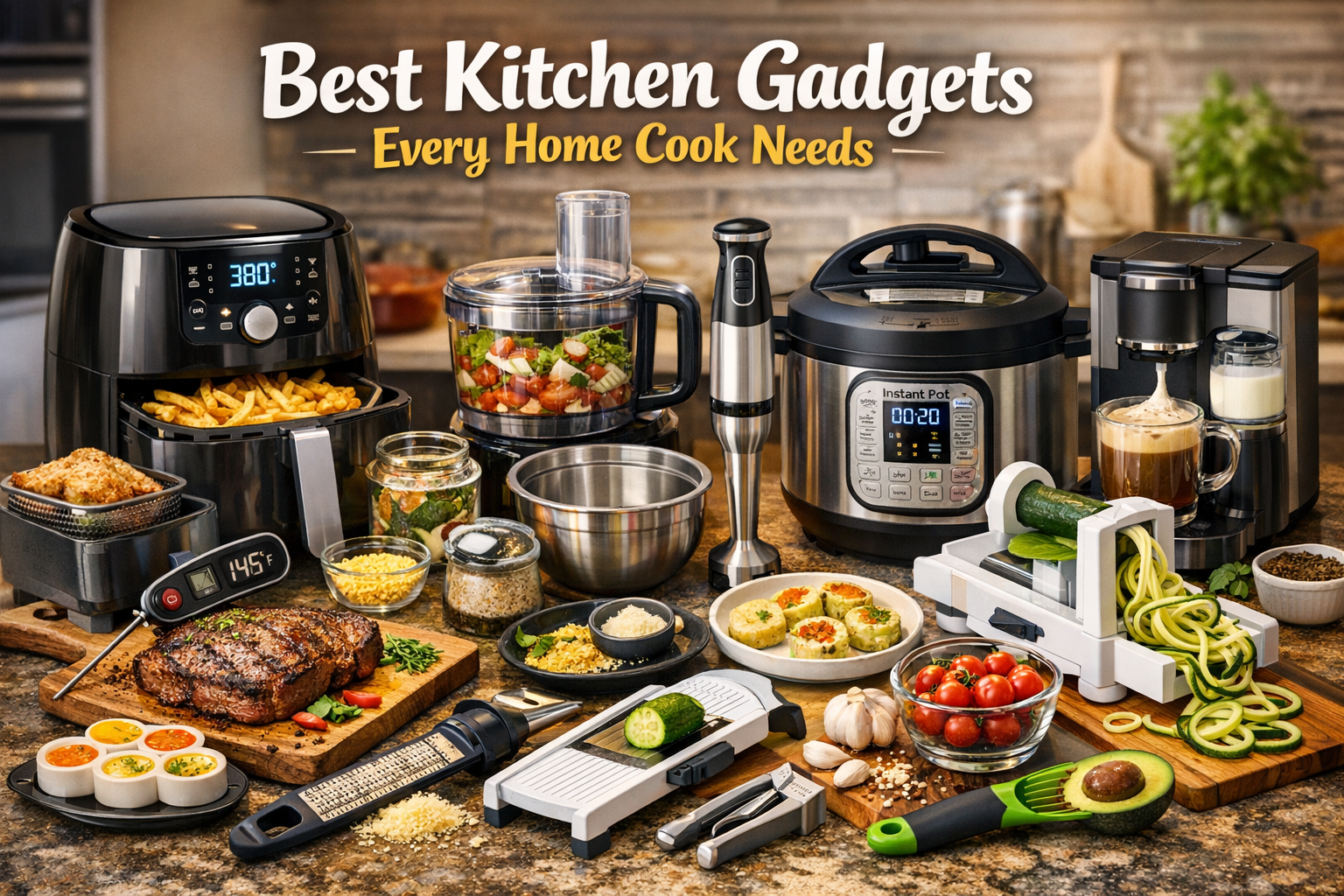

Here’s a confession that might resonate: at some point, most home cooks have a drawer. You know the one. The drawer where the avocado slicer lives next to the strawberry huller, the pineapple corer, the egg separator that seemed brilliant for thirty seconds in the store, and three different versions of a garlic press because none of them worked the way the packaging suggested.
Kitchen gadgets have a seductive quality. You see them demonstrated by someone impossibly competent, they solve a problem you’ve been tolerating for years, and the price seems reasonable for the convenience they promise. And then you get home and realize that the problem they solve was minor, the gadget itself is harder to clean than the original method, and it takes up space that could go to something you actually use.
The internet doesn’t help. Search “best kitchen gadgets” and you’ll find lists of forty, fifty, sixty items — some genuinely essential, some clever novelties, some sponsored content dressed up as honest advice. The signal gets buried in the noise.
So here’s what this guide actually is: an honest, opinionated, experience-based breakdown of the kitchen tools that genuinely transform how you cook — the ones that earn their space, justify their cost, and get used not once or twice but regularly, reliably, every week. Organized by how much they change your cooking, with honest notes on what each one does and doesn’t do well.
No avocado slicers. No single-purpose gadgets with a fifteen-second use case. Just the tools that make cooking faster, better, more consistent, and more enjoyable.
Let’s start with the things that matter most.
Before We Talk About Gadgets: The Philosophy That Makes This List Useful
A kitchen tool earns its place by doing at least one of three things: it saves meaningful time, it produces a noticeably better result than the alternative, or it makes a task significantly easier. Ideally all three.
If a tool does none of those things — if it’s solving a problem that a knife and thirty seconds of effort already solves — it’s not a tool. It’s a decorative commitment to a cleaner cutting board. The best kitchen gadgets are the ones you stop thinking about because they’re just part of how you cook. They become invisible through constant use.
With that standard in mind, here’s the list.
The Absolute Essentials: Tools That Change Everything
1. A Good Chef’s Knife (8-Inch)
This is listed first because it is, without qualification, the most important tool in any kitchen. Not a set of knives. Not a knife block with eight specialized blades you’ll use twice a year. One excellent chef’s knife, maintained well, will handle ninety percent of everything you ever need to cut.
The difference between a genuinely sharp, well-balanced chef’s knife and the kind of dull, heavy knife most people tolerate is not subtle. A sharp knife is safer — it goes where you direct it rather than sliding unpredictably. It’s faster — tasks that take three minutes with a dull knife take forty-five seconds with a sharp one. And it’s more enjoyable — there’s a reason professional cooks talk about their knives with genuine affection.
What to look for: A blade between 8 and 10 inches for most people. Full tang construction (the metal runs the full length of the handle) for balance and durability. A comfortable grip that fits your hand. German steel (Wüsthof, Henckels) tends to be slightly heavier and more durable but requires more frequent sharpening. Japanese steel (Shun, Global, Mac) holds an edge longer but is more brittle and needs more careful handling.
What it doesn’t replace: A paring knife for small detail work, and a serrated bread knife for bread and tomatoes. Those two additions give you a complete three-knife setup that covers essentially everything.
The maintenance caveat: A good knife that isn’t sharpened regularly is just an expensive dull knife. Buy a honing steel (to realign the edge between sharpenings) and a whetstone or use a sharpening service twice a year. This is non-negotiable.
2. An Instant-Read Thermometer
If you have one piece of equipment that produces a measurable, immediate improvement in your cooking — particularly your protein cooking — it’s a thermometer. Not because temperature is the only thing that matters, but because the alternative to a thermometer is guessing. And guessing is why chicken breast is dry, why pork is overcooked, why steaks are not what you ordered, and why roasts come out inconsistently despite using the same recipe every time.
An instant-read thermometer removes the guessing. The needle goes in, the number comes up within three to five seconds, and you know — with certainty — whether the food is done. No more pressing the meat and estimating by feel. No more cutting into things to check and losing all the resting juices. Just a number and a decision.
What to look for: Speed (under five seconds) and accuracy (±1°C or less). The Thermapen brand has an almost mythic reputation among serious cooks and is genuinely worth the price. ThermoWorks also makes a less expensive alternative that performs very well. Avoid the cheap dial-face models — they’re slow and often inaccurate.
Key temperatures to know off the top of your head:
- Chicken: 74°C (165°F)
- Pork: 63°C (145°F) with a 3-minute rest
- Beef (medium-rare): 54–57°C (130–135°F)
- Beef (medium): 60–63°C (140–145°F)
- Fish: 63°C (145°F)
- Bread: 93–96°C (200–205°F) for doneness
Once you start cooking with a thermometer, cooking without one feels like driving without a speedometer. Technically possible. Not how you want to do it.
3. A Kitchen Scale
Volume measurements — cups, tablespoons, teaspoons — are genuinely imprecise. A cup of flour packed into a measuring cup by one person is meaningfully different from a cup spooned lightly by another. These differences matter in baking, where the ratio of flour to liquid determines whether you get a tender crumb or a dense brick. They matter less in cooking but still matter more than most people realize.
A kitchen scale eliminates this imprecision entirely. It measures what’s actually there, not what you hope is there. And beyond accuracy, it’s faster — no measuring cups to wash, no wondering if you leveled the flour correctly, no scraping the cup clean over the bowl. Put the bowl on the scale, zero it, add ingredients, zero again, add more.
What to look for: A scale that measures in both grams and ounces (grams are more precise for small quantities), with a capacity of at least 5kg, a tare function (to zero out the weight of the bowl), and a readability of 1 gram. Compact, easy to clean, easy to store. The OXO Good Grips scale and the Escali Primo are both reliable and affordable.
The baking argument is the strongest one. If you bake — bread, cakes, cookies, pastry — a scale is not optional. It’s the difference between consistent results and Russian roulette with your oven.
4. A Cast Iron Skillet (12-Inch)
Covered in considerable depth in a separate guide, but worth including here because it genuinely belongs on any honest list of essential kitchen tools. The sear on a steak, the crust on cornbread, the crispiness of chicken skin — these results are tied directly to the heat retention properties of cast iron in a way that other pans can’t match.
A 12-inch skillet handles most cooking tasks comfortably and can go from stovetop to oven without issue. It’s the most versatile single pan in most home kitchens, it improves with every use, and it will last longer than anything else you own.
The practical note: Cast iron is heavy. If lifting a 5kg pan is a physical challenge, enameled cast iron (lighter) or carbon steel (significantly lighter, similar properties) are worth considering instead.
5. A Sturdy Cutting Board (Large)
Most people’s cutting boards are too small. The instinct to save counter space produces boards that require folding vegetables to fit them, that shoot liquids off the edge when you cut fruit, and that send food to the floor when you’re trying to transfer chopped onion to a pot. A large cutting board — at least 45 x 30cm — changes how confidently and efficiently you can prep food.
Wood or plastic? Both have genuine arguments. Wood is gentler on knife edges, more beautiful, and — contrary to old advice — no less hygienic than plastic when cleaned properly (wood has antimicrobial properties that plastic lacks). Plastic is dishwasher safe, lighter, and more practical for raw meat. The best solution is both: a large wood board for general prep, a plastic board dedicated to raw meat and fish.
What to look for in a wood board: End-grain boards (where the wood fibers run vertically) are gentler on knife edges and self-heal minor cuts better than edge-grain boards. Heavy enough to stay in place (rubber feet help). Thick enough not to warp. Maple and teak are both excellent choices.
6. A High-Quality Blender
A good blender — genuinely powerful, not the sixty-dollar models that give up when they hit anything more challenging than a ripe banana — opens up a category of cooking that’s difficult to access otherwise. Silky smooth soups. Restaurant-quality nut butters. Smooth sauces and dressings. Green smoothies that are actually smooth rather than texturally confusing.
The difference between a cheap blender and a Vitamix or Blendtec is jarring. The powerful blenders don’t just blend faster — they process fibrous materials and ice in a way that cheaper motors simply can’t achieve, producing genuinely smooth results in a fraction of the time.
The honest caveat: High-end blenders are expensive — typically in the $400–700 range new, though refurbished Vitamix models offer excellent value. For frequent blender users, the investment is justified quickly. For occasional users, a mid-range model (Ninja, Oster, or similar) in the $80–150 range may be adequate.
What a good blender makes possible: Velvety pureed soups without straining. Nut milks. Whole fruit smoothies. Nut butters. Hummus smoother than any food processor can achieve. Frozen cocktails and blended coffees. The applications expand the more you experiment.
Very Useful: Tools That Earn Their Counter Space
7. A Dutch Oven (5–7 Quart)
A Dutch oven — a heavy, enameled cast iron pot with a tight-fitting lid — is the best vessel for braising, slow cooking, soups, stews, and bread baking that exists in the home kitchen context. It holds heat brilliantly, goes from stovetop to oven seamlessly, distributes heat evenly, and the tight lid creates a moisture-sealing environment that’s essential for long braises.
Le Creuset and Staub are the premium options — expensive, but genuinely excellent and essentially indestructible. Lodge makes a more affordable enameled option that performs admirably. Any of these, treated reasonably well, will last decades.
The surprise use case: No-knead bread baked in a Dutch oven. The enclosed environment traps steam that the bread produces during baking, which creates a crackling crust that home ovens normally can’t produce. If you’ve ever wanted to bake a bakery-quality loaf at home, a Dutch oven is the piece of equipment that makes it possible.
8. A Food Processor
A food processor and a blender are different tools that do different things. Where a blender handles liquids and produces smooth textures, a food processor handles solids and produces chopped, sliced, grated, or roughly processed results. It’s the tool for pie crust (pulsed to just-combined, evenly distributed fat), for finely chopped onion without tears, for shredded cabbage in thirty seconds, for hummus, for breadcrumbs, for cookie dough.
The honest limitation: Food processors are bulky, somewhat difficult to clean (multiple parts), and for many tasks, a good knife and technique is comparable or better. They earn their keep for people who cook regularly and in volume — making large batches of dough, processing large quantities of vegetables for meal prep, or making pastry frequently.
What to look for: A capacity of at least 11 cups for most home cooking tasks. A strong motor (at least 600 watts). A pulse function. Multiple blades and disks for slicing and shredding. Cuisinart has long been the reliable standard. KitchenAid’s models are also excellent.
9. An Immersion (Stick) Blender
If a full-size blender feels like too much commitment or counter space, an immersion blender is the practical middle ground — and for certain tasks, it’s actually better than a full blender because it goes directly into the pot.
Pureeing soup directly in the pot without transferring boiling liquid to a blender (a genuinely dangerous process that involves holding the lid down while hot liquid tries to expand) is the immersion blender’s greatest contribution to home cooking safety and convenience. It also makes salad dressings, whipped cream, mayonnaise, and smoothie-style drinks with dramatically less cleanup than a full blender.
What to look for: Variable speeds, a detachable blending arm (for easier cleaning), and adequate power for most tasks (200 watts or more). Breville, Cuisinart, and KitchenAid all make solid options. The Vitamix immersion blender is the premium choice.
10. A Mandoline Slicer
A mandoline produces slices of vegetables with consistent thickness that’s genuinely difficult to achieve with a knife — and for certain dishes, that consistency matters. Paper-thin cucumber for a salad. Even potato slices for a gratin. Uniform fennel for a slaw. The mandoline does in ten seconds what takes a skilled knife user two minutes.
The crucial caveat: Mandolines are dangerous. Genuinely, seriously dangerous in a way that’s hard to overstate. The blade is extremely sharp and often fixed in position with nothing between your fingers and the blade except your attention. Cut-resistant gloves are not optional — they’re required equipment for anyone using a mandoline. Take this seriously.
What to look for: A sturdy construction that doesn’t wobble on the counter. Adjustable thickness settings. A hand guard (though the hand guard that comes with most mandolines is poorly designed — get separate cut-resistant gloves). OXO, Benriner, and KitchenAid all make reliable options.
11. A Microplane Zester/Grater
The Microplane is one of those tools that seems minor until you start using it regularly, at which point you reach for it constantly. Originally designed as a woodworking rasp (really), the Microplane produces fine, fluffy grated material from hard ingredients that other graters can’t match — lemon zest without the pith, finely grated parmesan that melts instantly into pasta, fresh ginger that’s smooth rather than fibrous, nutmeg freshly grated over béchamel.
These might sound like small things. They’re not. Fresh lemon zest in a dish changes the flavor profile dramatically compared to bottled lemon juice. Fresh parmesan grated over pasta versus pre-shredded from a bag is a completely different experience. Freshly grated nutmeg has an intensity that pre-ground nutmeg lost six months ago.
What to look for: The classic long, narrow Microplane grater in the “fine” or “zester” grade. It costs around $15–20 and does more for your cooking per dollar than almost anything on this list.
12. A Bench Scraper
A bench scraper — a flat, rectangular metal blade with a handle — is one of the most useful tools in a kitchen and one of the least recognized. It’s designed for bread baking (dividing dough, cleaning the work surface, lifting and moving dough) but earns its place in general cooking too.
Use it to transfer chopped vegetables from the cutting board to the pan in one smooth motion without losing half of them. Use it to clean the cutting board of debris between tasks. Use it to portion soft foods cleanly. Use it to scrape residue from the stovetop or countertop. It’s a two-second cleaner, a one-motion transfer tool, and an indispensable bread-making accessory.
Cost: Around $10–15. Genuinely one of the best value-for-money kitchen purchases available.
13. A Kitchen Timer (Separate from Your Phone)
Hear me out before dismissing this as unnecessary in the smartphone era. Using your phone as a timer means unlocking your phone every time you want to check it. It means being distracted by notifications while your pasta overcooks. It means the timer is sometimes in another room, or silenced, or has a dead battery at the least convenient moment.
A dedicated kitchen timer — magnetic, attached to the fridge or the stovetop range — is always in the kitchen, always audible, always available. It sounds like a minor quality-of-life improvement and turns out to be surprisingly meaningful in actual cooking practice.
What to look for: Clear display, loud alarm, multiple timers simultaneously if you often have more than one thing cooking, magnetic backing for fridge or appliance attachment. ThermoWorks makes an excellent model. OXO has reliable, simple options.
14. Kitchen Shears
Good kitchen shears — not regular scissors that happen to be in the kitchen, but actual heavy-duty kitchen shears — make specific tasks dramatically faster and easier. Cutting pizza into slices in the pan. Snipping fresh herbs directly into a dish. Cutting dried fruit or sun-dried tomatoes. Breaking down poultry (especially spatchcocking a chicken). Cutting parchment paper to fit a pan. Opening packaging without the drawer-of-disaster junk scissors.
What to look for: Heavy-duty construction (thin scissors won’t cut through chicken joints). Blades that separate for cleaning. Comfortable handles. Wüsthof, OXO, and Kershaw all make reliable options.
15. A Salad Spinner
Wet salad greens dilute dressing, make greens limp faster, and generally produce a worse salad. A salad spinner — which uses centrifugal force to remove water from washed greens — is the tool that makes salad worth bothering with at home.
Beyond greens, a salad spinner is useful for washing and drying herbs, draining cooked pasta for dishes where water content matters, washing and drying berries, and rinsing and drying fresh vegetables.
What to look for: A large enough capacity to wash and spin a full head of lettuce or a large bunch of kale in one batch (at least 5 quart capacity). A mechanism that works smoothly and a bowl that can be used as a serving bowl to save washing up. OXO makes the most consistently recommended salad spinner in the home cook market.
Nice to Have: Gadgets That Earn Spots in Certain Kitchens
16. A Stand Mixer
The KitchenAid stand mixer is one of the most iconic pieces of kitchen equipment available and one of the most useful — for a specific type of cook. If you bake bread, cookies, cakes, or meringues regularly, a stand mixer with its hands-free operation and powerful motor is transformative. You can walk away while it kneads dough. You can fold in ingredients while doing something else. The dough hook, paddle, and whisk attachments cover an enormous range of tasks.
The caveat: Stand mixers are expensive (typically $300–600 for a reliable model), large, and heavy. If you’re not a frequent baker, they don’t earn their counter space. If you are — particularly if you make bread or regularly bake in volume — they earn it every week.
An honest note on attachments: The pasta maker, meat grinder, and ice cream maker attachments for KitchenAid stand mixers are genuinely useful if you use those specific functions regularly. The vegetable spiralizer and spiralizer attachments are less universally useful — the standalone versions do the job more simply for most people.
17. An Electric Kettle
Boiling water on the stovetop takes longer than it needs to, and for anyone who makes tea, pours hot water over coffee grounds, or frequently needs boiling water for cooking, an electric kettle is a meaningful time-saver. Good models heat a full liter in under three minutes, compared to five to eight minutes on a stovetop.
The variable temperature argument: For serious tea and coffee enthusiasts, a variable temperature kettle — one that lets you set the temperature to 70°C for green tea, 85°C for pour-over coffee, 100°C for boiling — is worth the additional cost. The temperature of water genuinely affects the extraction of both tea and coffee, and having precise control produces noticeably better results.
18. A Pepper Grinder (Manual or Electric)
Pre-ground pepper loses its volatile oils and pungency within months of grinding. Freshly ground pepper from a good grinder is meaningfully more aromatic, more flavorful, and more present in a dish. This is one of those simple swaps that improves everyday cooking with zero effort beyond owning the right tool.
What to look for: A grinder with a ceramic or stainless steel grinding mechanism (both are more durable than carbon steel, which can corrode). An adjustable grind setting from fine to coarse. Peugeot is the traditional premium brand. OXO makes a reliable, affordable option. The electric versions are useful for people with arthritis or who grind large quantities.
19. A Rice Cooker
For regular rice eaters — particularly those who eat rice multiple times a week — a rice cooker eliminates the one variable that makes stovetop rice unreliable: attention. Set the ratio, press the button, walk away. The rice cooker knows when it’s done and switches to “keep warm” mode automatically. The result is consistently good rice with zero risk of burning the bottom or undercooking the center.
For occasional rice eaters: The stovetop method, once understood (and it’s simpler than it seems — covered in a separate guide), works perfectly fine without a dedicated appliance. The rice cooker earns its counter space only for people who use it frequently.
20. A Vacuum Sealer
A vacuum sealer has one primary argument: preserving food significantly longer than conventional storage. Meat that would last three days in the fridge lasts ten to fourteen days vacuum sealed. Cheese that would dry out and develop mold in a week lasts a month. Marinating is dramatically accelerated — the vacuum process forces marinade into the food rather than just coating the surface.
The sous vide argument is the second one. Vacuum-sealed bags are the standard vessel for sous vide cooking, and if you own an immersion circulator, a vacuum sealer pairs with it naturally.
The caveat: Vacuum sealers require proprietary bags, which are an ongoing cost. They’re relatively bulky. And the freezer is already an effective long-term food preservation tool for most people’s needs. The vacuum sealer earns its place in kitchens where significant quantities of food are purchased in bulk or where sous vide cooking is a regular practice.
Gadgets That Sound Useful But Rarely Earn Their Keep
In the spirit of honesty, here are a few tools that appear on many kitchen gadget lists and are genuinely less essential than they seem:
Garlic press. Minced garlic on a cutting board with a knife takes thirty seconds. Garlic presses have multiple small holes that are tedious to clean, they waste more garlic than a knife does, and many cooks prefer the slightly different texture and flavor of knife-minced versus pressed garlic anyway. Smash the clove with the flat of your knife and mince. Skip the press.
Apple slicer/corer. A knife handles this in fifteen seconds. An apple slicer/corer handles it in four seconds. That eleven-second difference does not justify the cabinet space.
Avocado slicer. A knife, a spoon, and thirty seconds. No single-purpose gadget needed.
Electric can opener. A good manual can opener costs eight dollars and works for years. An electric can opener costs fifty dollars and breaks.
Egg separator. Your hands work perfectly. The yolk sits in your palm, the white drains through your fingers. Done.
Spiralizer (standalone). Useful if you make vegetable noodles frequently and specifically enjoy them. If you’ve made zucchini noodles twice and they’re still in the “intending to do again” category, a spiralizer is a large plastic object that will live in your cabinet.
How to Actually Build Your Kitchen: A Practical Sequence
The mistake most people make is trying to kit out a complete kitchen all at once, buying everything at a moderate quality level. The better approach is progressive investment — start with the true essentials at good quality and add from there.
Phase 1 — The Non-Negotiables (Buy These First): Chef’s knife, cutting board, instant-read thermometer, kitchen scale, and a large skillet (cast iron or stainless). With these five things, you can cook everything.
Phase 2 — The High-Value Additions: Dutch oven, immersion blender, Microplane, kitchen shears, bench scraper. These add capability and convenience without requiring significant counter space.
Phase 3 — Based on What You Actually Cook: Food processor if you bake pastry or do heavy vegetable prep. Stand mixer if you bake bread or cakes regularly. High-powered blender if you make soups, smoothies, or nut butters frequently. Rice cooker if you eat rice multiple times a week.
Always last: The single-purpose gadgets, the novelty items, the things that solve one specific problem you encounter twice a year. These are gift-list items, not investment items.
The Maintenance Factor: The Thing Most Gadget Guides Skip
Owning good tools is half the equation. Maintaining them is the other half — and it’s where most people fall short.
Knives: Hone regularly (before or after each use) to keep the edge aligned. Sharpen on a whetstone or with a professional sharpening service two to four times a year depending on use frequency. Store on a magnetic strip or in a knife block — never loose in a drawer where the edges hit other metal.
Cast iron: See the separate cast iron guide for the full picture. The short version: season it, dry it completely after washing, wipe with a thin layer of oil before storing.
Cutting boards: Oil wooden boards monthly with food-safe mineral oil or a dedicated board conditioner. Dry immediately after washing — never soak or run through the dishwasher. Replace plastic boards when they develop deep grooves (bacteria harbor in those grooves).
Blenders: Blend warm water and a drop of dish soap immediately after use, rinse, done. Most blender jars are dishwasher safe but the heat degrades seals over time — hand washing extends their life.
Everything else: Read the care instructions, which exist for a reason and are often ignored.
Conclusion: Buy Less, Buy Better, Use It More
The single best piece of kitchen gadget advice available is this: resist the pull of novelty, invest deliberately in quality for the tools you use daily, and let everything else wait until you’ve identified a genuine, recurring need for it.
A $150 chef’s knife used every day for fifteen years costs less per use than a $30 knife replaced every two years. The instant-read thermometer that eliminates overcooked chicken pays for itself the second time you use it. The Dutch oven that braised everything from beef bourguignon to no-knead bread for the next decade justifies its cost the first winter you cook through.
The kitchen gadgets on this list — the chef’s knife, the thermometer, the scale, the cast iron skillet, the Dutch oven, the immersion blender, the Microplane — are not exciting purchases in the way that a new spiralizer or a specialized matcha whisk might be. But they’re the tools that transform cooking from a series of workarounds and approximations into something reliable, repeatable, and genuinely enjoyable.
Buy the good version of the things that matter. Learn how to maintain them. Use them constantly. And let the rest of the gadget market continue generating content for that drawer.
I’d love to know what’s in your kitchen that you consider non-negotiable — or what gadget you bought with high hopes that’s now living in the back of a cabinet. Drop it in the comments. Those real-world experiences are always more useful than any product description, and they often lead to the most genuinely helpful follow-up content.